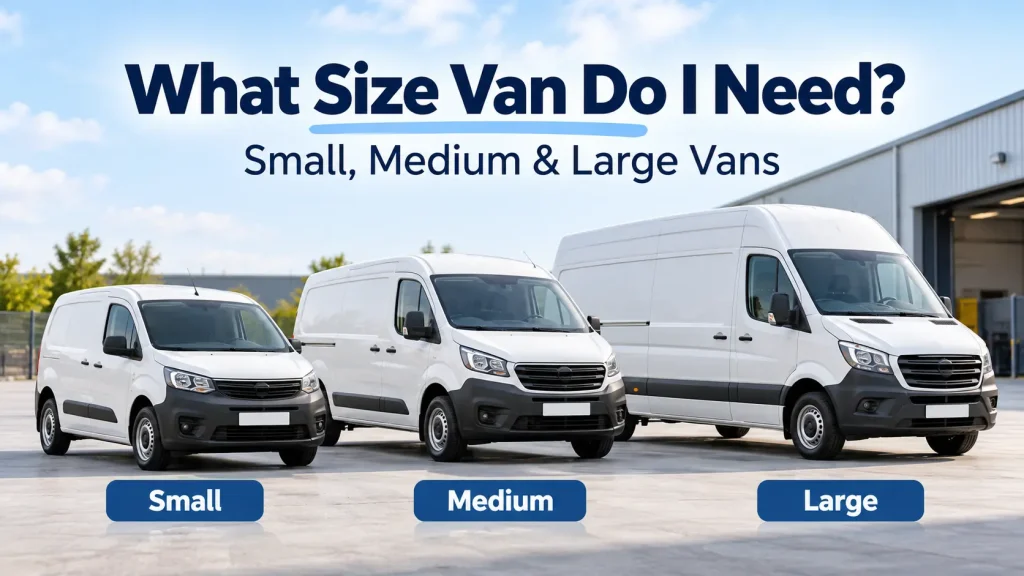
Choosing the right van size can make the difference between a job that goes smoothly and one that costs you a second trip — or leaves you trying to manoeuvre a vehicle that’s much bigger than you actually need.
Whether you’re moving house, transporting furniture, carrying tools and equipment, making business deliveries or simply need some extra load space for the day, it’s worth thinking about what you need before booking your van hire.
The three main options are small, medium and large vans. Each has its advantages depending on the size of your load, where you’ll be driving and how much space you have for loading and unloading.
Here’s a straightforward breakdown to help you choose the right van before you book.
A small van is the right choice for light loads, local deliveries and jobs where manoeuvrability matters more than maximum capacity.
Small vans are particularly useful when you’ll be driving around towns or cities, dealing with narrow streets, tight parking spaces or making multiple stops throughout the day. You get useful load space without having to drive something significantly larger than a normal car.
They can be a good option for tradespeople carrying tools and smaller equipment, businesses making local deliveries, or anyone transporting boxes, luggage and smaller household items.
If you’re moving a few boxes, collecting furniture, transporting some tools or making local deliveries around Belfast and across Northern Ireland, a small van will often be the most cost-effective option.
There’s little benefit in paying for a larger vehicle if you know everything will comfortably fit into a small van.
A small van is worth considering for:
The main thing to consider is whether your load will genuinely fit. If you’re likely to fill the available space completely, moving up to a medium van could give you some valuable extra room.
The medium van is the practical middle ground and one of the most versatile choices for van hire.
You get considerably more load space than a small van while still having a vehicle that is relatively straightforward to drive, park and manoeuvre.
For tradespeople and businesses, a medium van can provide enough room for a full day’s tools, equipment, materials or deliveries. For personal use, it can work well for flat-pack furniture, larger household items, boxes or a modest house or apartment move.
Medium vans are particularly useful when you’re carrying several different items and don’t want to spend the day trying to maximise every inch of available space.
A medium van can be ideal for:
If you’re unsure whether a small or medium van will accommodate everything, choosing the medium option can also reduce the risk of discovering at collection time that you don’t have enough load space.
For many everyday van hire requirements, a medium van offers a useful balance between load capacity, running costs and ease of driving.
When you need maximum load space, a large van is generally the better choice.
Large vans are designed for jobs where capacity is the priority. That could mean a full house move, transporting bulky furniture, moving business stock or carrying larger tools and equipment.
The biggest advantage is straightforward: you can carry considerably more in a single journey.
If choosing a smaller vehicle means making two or three trips, hiring a large van could ultimately save you both time and money.
Large vans are commonly suited to:
There is a trade-off. A larger vehicle requires more space to manoeuvre and park, particularly in residential areas or busy town and city locations.
Before booking, think about access at both ends of your journey. Check whether there are narrow entrances, height restrictions, tight parking areas or other obstacles that could make using a larger van difficult.
If access is good and you have a substantial load to move, choosing a large van can be far easier than trying to squeeze everything into a smaller vehicle.
The easiest way to choose between van sizes is to look at the largest items you need to transport rather than simply estimating the overall amount of belongings.
Start by making a quick list of what you’re moving.
If it’s mainly boxes, tools and smaller items, start with a small van. If you have furniture, equipment or a larger number of boxes, consider a medium van. For full house moves, bulky items or substantial commercial loads, a large van is likely to be more suitable.
You should also consider:
It can be tempting to automatically book the smallest van to reduce the hire cost, but that saving quickly disappears if you have to make an additional journey.
Equally, there’s no reason to book the largest vehicle available if a smaller van will comfortably handle the job.
Sometimes none of the three standard van sizes quite fits the job.
If you’re moving particularly bulky or irregular items and need additional height, width and easy loading access, a Luton van may be more suitable.
Luton vans are particularly useful for moves because their box-shaped load area provides excellent usable space for furniture, boxes and other bulky items.
For construction, landscaping and similar work, the type of vehicle you need can be completely different.
If you’re transporting building materials, waste, soil, aggregate or similar loads, a tipper is designed specifically for that type of work rather than trying to use a standard van.
Choosing a specialist vehicle can make loading, transportation and unloading considerably easier.
Load capacity isn’t the only consideration when choosing a van.
Think about where the vehicle will actually be used.
A large van might comfortably accommodate everything you need to move, but that doesn’t necessarily make it the best option if you need to navigate narrow streets or access a restricted property.
Consider the complete journey, including where you’ll collect the load, where you’ll unload it and where the van can be parked.
For house moves in particular, being able to park close to the property can save a considerable amount of time and effort.
One of the most common reasons people hire a van is moving house.
For smaller moves, a medium van may provide enough capacity, particularly if you’re moving from an apartment or only transporting part of the contents of a property.
For larger moves involving beds, wardrobes, tables, sofas and numerous boxes, moving to a large or specialist van can make more sense.
The goal should be to find the best balance between having enough space and choosing a vehicle you’re comfortable driving.
Remember that a slightly larger van that allows you to complete the move in one journey could be more convenient than making several trips in a smaller vehicle.
Van hire isn’t only for moving house.
Businesses across Northern Ireland use rental vans for everything from deliveries and additional seasonal capacity to temporary replacement vehicles and short-term projects.
If your requirements change from week to week, hiring can give you access to the right size of vehicle without having to maintain additional vans in your permanent fleet.
A small van might be